113 Years of Enduring Innovation
Celebrating Ebara’s Legacy
From a Centrifugal Pump Pioneer to a Global Technology and Innovation Leader
November 11th marks the 113th anniversary of Ebara’s founding, a remarkable milestone that highlights our company’s enduring strength, innovation, and ability to adapt as the world continues to evolve.
Ebara began its journey as the Inokuty Type Machinery Office, driven by the mission to deliver exceptional products based on centrifugal pump theory. In 1920, the company officially became EBARA CORPORATION, expanding beyond the Inokuty pump to pursue broader technological frontiers.
Ebara’s Journey
A Timeline of Key Milestones
Through the decades, Ebara continued to achieve significant breakthroughs:
1924
Contributed to Japan’s first axial flow pump.
1938
Relocated headquarters to the newly built Haneda Plant.
1956
Introduced new technologies and partnerships, launching a plan for small pump expansion through standardization and mass production.
1984
Updated to the modern Ebara logo we know today.
1991
Established Ebara Technologies, Inc. in the United States, marking the start of our global expansion.
Issey Hatakeyama
The Perseverance and Vision Behind Ebara
Behind Ebara’s industrial success stands Issey Hatakeyama (1881–1971), born in Kanazawa. Despite early hardship after his family’s fortune declined, Hatakeyama’s perseverance and determination led him to pursue education and innovation.
This ultimately led to the founding of the Inokuty Type Machinery Office in 1912, the origin of what would become EBARA CORPORATION. Guided by the belief that technology should advance society, Hatakeyama led Ebara through milestones such as Japan’s first axial-flow pump and laid the foundation for a company defined by ingenuity and integrity.
This profound vision of preserving culture and connecting traditions is also embodied by the Ebara Hatakeyama Museum of Art in Tokyo (www.hatakeyama-museum.org). Founded by Sokū Issei Hatakeyama, the private museum showcases approximately 1,300 Japanese, Chinese, and Korean artworks, including 6 National Treasures and 33 Important Cultural Properties, such as tea-ceremony utensils, lacquerware, and Noh costumes.
Following a recent renovation and expansion with a new wing in Autumn 2024, the museum is reborn, better equipped to share these treasures with a global audience. His strength of character and multifaceted vision continue to shape Ebara’s identity today.
Taking Pride in Our Past, Focused on E-Plan 2025
As we celebrate this milestone, President Hosoda encourages all employees to take pride in Ebara’s history and look forward with unity and focus as we advance toward the goals of E-Plan 2025.
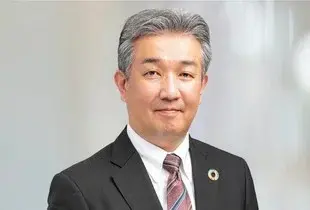
Shugo Hosoda
Director, CEO & COO